T H E Y A R E L E G I O N T H E Y A R E L E G I O N T H E Y A R E L E G I O N T H E Y A R E L E G I O N T H E Y A R E L E G I O N T H E Y A R E L E G I O N T H E Y A R E L E G I O N T H E Y A R E L E G I O N T H E Y A R E L E G I O N T H E Y A R E L E G I O N T H E Y A R E L E G I O N T H E Y A R E L E G I O N T H E Y A R E L E G I O N T H E Y A R E L E G I O N T H E Y A R E L E G I O N T H E Y A R E L E G I O N T H E Y A R E L E G I O N T H E Y A R E L E G I O N T H E Y A R E L E G I O N T H E Y A R E L E G I O N
Foreword
Borsos Lőrinc (János Borsos and Lilla Lőrinc) were members of the Evangéliumi Keresztények Gyülekezete (Evangelical Christian Church) in Székesfehérvár between 2003 and 2010, and later of the Omega Gyülekezet (Omega Church) in Budapest. The former community split from Hit Gyülekezete (Faith Church) during the notorious schism of 1998 and reorganized itself as an autonomous congregation, while the latter was founded in Budapest in 2004 by the Kármel Pünkösdi Gyülekezet (Kármel Pentecostal Church) of Pécel.
During this period, the artists largely set aside their visual art practice and focused primarily on building the community: they hosted weekly home-group meetings in their apartment and proselytized in Budapest underpasses. Toward the end of this nearly seven-year period, after distancing themselves from the congregation, they began creating work under a shared name. Another seven years later, they started to address the years spent within the community as a subject of their artistic practice.
The following text is a meta-diary reflecting on the period described above. It was written in 2021 for the Transrealism series on Tranzitblog, edited by Gyula Muskovics. The text alternates between notes, dreams, quotations, and descriptions of artwork ideas originating from parallel timelines, complemented by drawings and additional visual elements. The editing of the text and the development of the visual material are credited by Borsos Lőrinc, while the HTML environment was created by Előd Janky.
Hunter S. Thompson: Fear and Loathing in Las Vegas
We need community. In the course of our fictional or real, social or unsocial existence*, we try to create for ourselves a milieu, a bubble, that is safe yet allows as much freedom of movement as possible. A space others can also connect to, with loose or tighter bonds, the most different kinds of characters: creators, friends, lovers. The milieu is subject to constant change. For this mutation to unfold without rupture, flexible walls and patience are required. Although the walls grow tougher through use, increased pressure always carries the danger that the bubble may burst. Add ideology or paranoia and a state of war can easily set in. The walls become impenetrable, and the milieu turns into a fortress, or a prison. Life, however, is not so easily shut out. Sooner or later it finds its way through any wall. It seeps slowly through the cracks, but if necessary it can bring the entire structure crashing down on us.
(* Immanuel Kant, Confessions of a Cosmopolitan).
What kills you also makes you stronger.
Collapse is a traumatic experience, but also a long-missing act of looking into the mirror. Although the illusion of stability instantly dissolves in the moment of loss, it becomes clear what has survived, in other words, what is worth building on from that point forward. Because among the debris scattered around us, things we once believed to be important, there are always a few that seem to remain in place despite the upheaval, things we cannot live without. In moments like these, a deeper layer begins to show through the wounds, a layer from which the structure may grow again. The process of redesigning and beginning to build again marks a critical period; at such times we drop out of the social game called socialization for a few turns.
•:•.•:•.•:•:•:•:•:•:•:•☾☼☽•:•.•:•.•:•:•:•:•:•:•:•
A famous businessman once explained it to us this way. He owned a Jaguar XJ, and the newspapers later wrote about him that he had committed embezzlement. The time required for regeneration, he said, is far longer than the path that leads to burnout. Identity needs rest and the patient support of its environment until it regains its strength, only to face once again the possibility of its own end. In this identity-digesting, peristaltic movement, contractions are regularly followed by expansions, and then everything begins again from the start. Something like this: life shits us out just so it has something to eat.
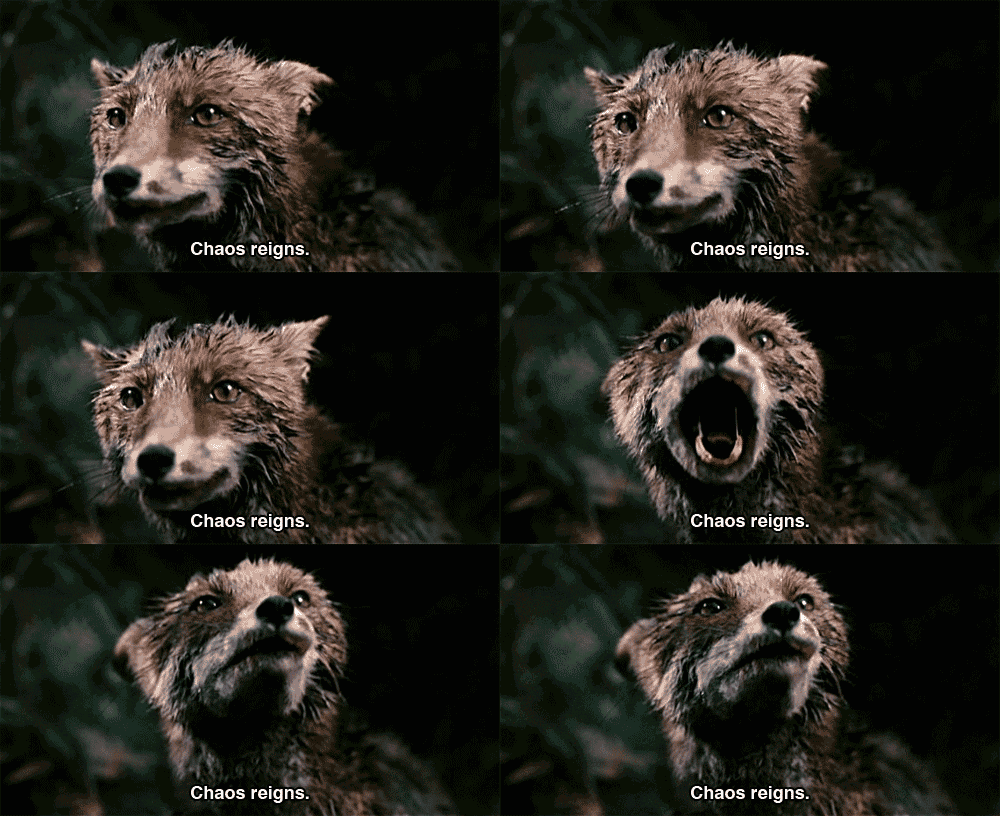
“Chaos reigns,” says a fox in Lars von Trier’s film Antichrist. Nature chooses an animal as its mouthpiece, one that addresses humans in human language, declaring a state of emergency. As if humanity needed to be told separately that its status as apex predator is slipping away, that by feeding the illusion of progress it only makes its own endgame more dramatic. Because in the end, nature always has the final word. Even if humans retreat behind walls and rules, they remain just as vulnerable. The tribulation may strike at any moment, and it will; it is only a matter of time.
(2019, Chaos Reigns, work description, excerpt)
The rat level in New York (Supreme) sits directly above the bedbug and cockroach level, but well below the raccoon level (a visually unobservable experience). It lies beneath the level of pigeons and the “American fuck-buzzard” (in Hungarian: starling / gang boss, with four or five sparrow lackeys). The squirrel level is presumably located just above the raccoon level. It stretches from the grass up to the top of the tree canopy, including climbing up and down the fences of public basketball courts, talking back, and making frequent references to hazelnuts.
“How you gonna fill unfillable?”
(HTRK, Mentions)
The feeling of emptiness is significant, as if a chapter had come to an end. The shock of separating from the community, like being torn from a mother’s womb, lingers like a shadow for a while, until your brain rewires itself. Then you calm down and begin to find new goals. We often used the term “returned to the world” for those who could not integrate into the community in the long run and eventually left. We pitied and looked down on these people, because we believed that if someone did not belong to a community, they could not have a real relationship with the Creator, since the church is His body. Perhaps we would have been more empathetic if we had known that it was only a matter of time, and that the same fate awaited us as well...
One of the leaders, I remember, even joked that the only way to leave this club was to die. As far as I know, he has since become a defector himself, though he still occasionally meets up for beers with a few others who also jumped ship. A few years ago, when I performed at Toldi, he came and listened. He said it was intense, something he had never heard before, but it seemed he liked it.
ᐱ
If you want a higher mountain, dig around it.
You have to slam on the brakes in the fog, unless you want to crash straight into it. But you are not going to speak against the flock. You do not want to be a downer. Criticism belongs in private, face to face, preferably with the person responsible. But what if you do not know who that person is, and instead keep your observations to yourself? The circle closes. At the first sign that criticism is forming, you collapse inward, assuming you must have misunderstood something. Then, when the opposite slowly begins to dawn on you, you look for some alternative way to express your opinion, for example the Omega files. And finally you begin to regurgitate the things you had swallowed for years without chewing, just so the experience of flow would not be interrupted.
You hit a wall and the investigation begins. You realize you fucked up, but not only you. Everything is fucked up. The system itself is flawed from the start. There is nothing to do except accept it. Fucking ideas, it is always what you do not have that you want. For a moment you glimpse something sublime, and suddenly everything else turns grey. After that, it is the only thing you want. You cannot reach it, but you cannot forget it either. The feeling of failure arrives, followed by compensation, drugs for example. There is no resolution, only the terrible pull of the depth, the call of the void.
Some people, for example, developed a habit of attending barrel blessings.
“You fuck! You’re draining my brothers’ nectar!”
The whole thing was like an infinite vomiting condensed into a single moment, but somehow I managed to grab hold of the toilet flush lever. I grabbed it, or they grabbed my hand somehow. From the dark, dense forest of self-accusations, where every tree leaned toward me, pointing only at me with its stupid little sign marked guilt, I was suddenly pulled onto some kind of mental plateau. I stood there at the site of a covenant, beyond time and space, with a map in my pocket.”
Father: “Which tempers steel better, fire or ice?”
Son: “Fire.”
Father: “Are you sure?”
Son: “Ice?”
(The father snaps the sword in half with a single blow.)
Father: “Fire and ice. That is the secret of steel.”
(Conan the Barbarian, 2011)
You balance on a cord above an abyss, somewhere between the status of believer and non-believer. You stepped onto the bridge when you gave up your former life so that by the time you reach the other side you might be transformed into something new. Everything or nothing. You inch forward under extreme conditions. The wind grows stronger, and you either see into an absurd distance or not even the next centimetre ahead. But will you arrive on the far shore as a “knight of faith,” or turn back and leave empty-handed like a “tragic hero”**?
Is it impossible that you might never want to arrive anywhere at all, but simply live there on the rope, above the abyss? To cling to Sodom like Lot, yet still step away before the bomb is dropped? To watch immense structures collapse and still survive?
(**Søren Kierkegaard, Fear and Trembling)
There are no excuses, only exceptions.
Amid the delusions of artistic uselessness, Doom was running at full blast. But cheating in god mode and tearing through the levels isn’t exactly ballsy. You can upgrade the character, but why bother? The world, the resistance of the environment, grows stronger together with the character. The illusion of progress is maintained through intimidation: if you do not work, you do not develop; if you do not pay, you fall behind. But what is the point of marching across someone else’s map when we could be moving on our own? Especially if we can play by our own rules...
┌∩┐(◣_◢)┌∩┐
“Szopjatok le mind!”
(“All of you, suck my dick!” — Lilu, Viva TV)
(...) 🔮
and then the stone was there in my hand the so-called “cheetah-man stone.” something that, if you walk past it, is fucking awesome. carved, ornate, glittering. the handprint of some great man, strong as hell!
and then suddenly, out of sheer defiance, I threw the stone away, fuck it, into a big pile into the shed, into nothing, let it rot there!
and then someone from the housing estate, some kind of spy-freak, screeched down from the tenth floor: “who the fuck is causing trouble down there?”
but I kept going, slipped into the workshop, among stones and iron, among rusty wagons.
and there was the sleeping worker. he was breathing heavily and groaning, then as he woke up he turned into a woman. and then, wearing this kind of head-apron, with a blunt, obscene gesture, she asked suggestively: – what is the future of the artist?
and I stared into the distance and burst into tears: – hopeless.
and then the spirit took me into a huge exhibition where Kassáks were spinning, whirling from room to room, hammers and animations, in a kind of William Kentridge style. merry-go-rounds, projections, everything.
whoever made it was going big, some anachronistic, never-existed Hungarian superstar. a fucking circus!
then Szentjóbi was explaining his work: a split image with little lines, which, according to him, “was printed with Gréta grapes, because that’s all there was.”
so in the end there was no catharsis, for fuck’s sake.
(1 October 2019, MeetFactory, Prague)
God works through everything. So the will to live is present in everyone. On the other hand, some people hate fags. 🧤
(...)
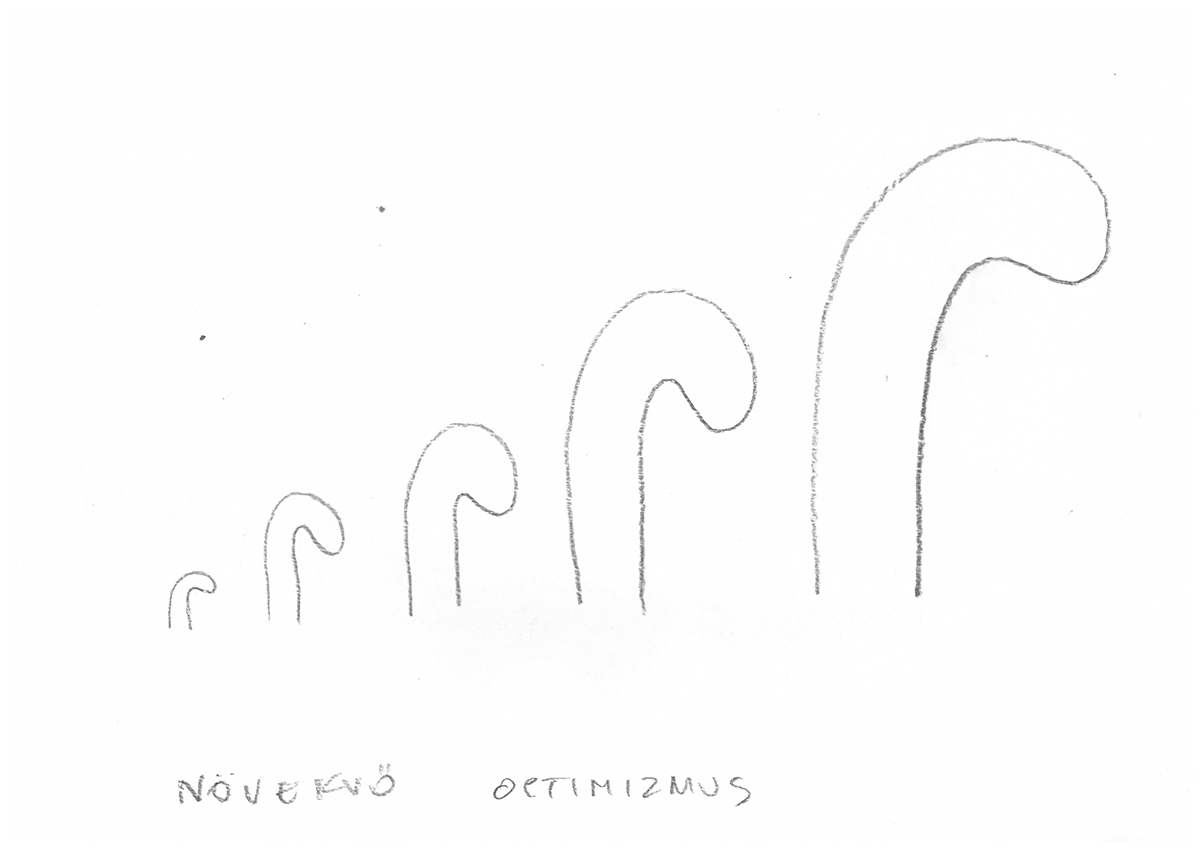
Fathers once sacrificed themselves for the community. In return, we now have to entertain them, to dance the way they whistle.
If we owe them this, then what do we owe ourselves? Because there would be plenty of ways to want to live here too!
But by the time we prove our way of living, we will have become fathers ourselves: no longer jumping around, but whistling.
And in the place of the old fathers new ones rise,
you’d lose your shit!
(Growing Optimism)
to do: lock myself inside a gallery with Joseph Beuys
– but he’s dead!
– yeah, then death.
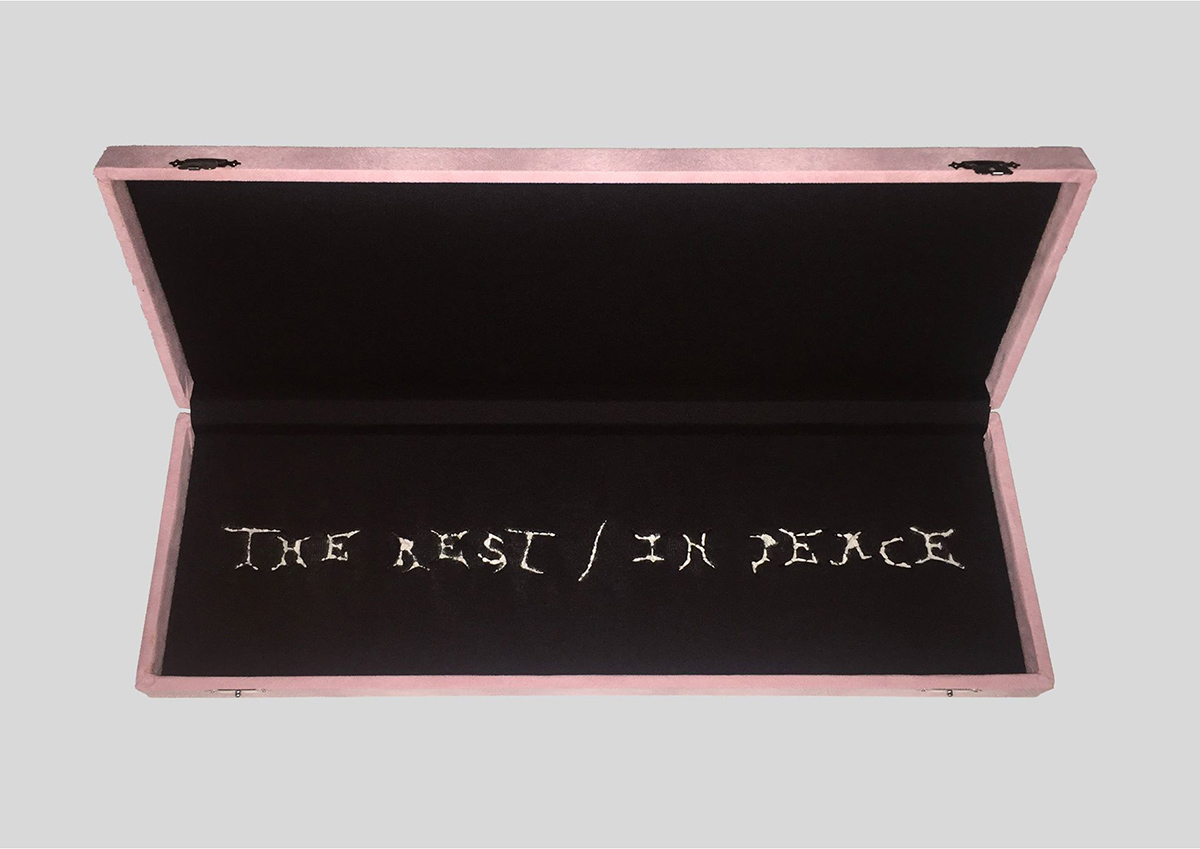
A moral and cultural crisis sets a given milieu against itself and slowly grinds it down. Yet it always produces resistance, and with it the possible routes of escape. We are interested in finding the latter. Although we have always been an Eskimo country, cannibalism has rarely been this close to our throats. The number of seals on the verge of extinction has been drastically reduced, and those that remain are plagued by various diseases. If we fail to find new hunting grounds, there will be no other option but to devour one another. Of course, if we prefer not to take part in that, we may migrate to another habitat. Unfortunately nothing guarantees that the Eskimo crisis will not catch up with us there as well. We can also dig our own graves if we are in the mood for a radical solution, and perhaps that is exactly what we will do. We will die complaining, and then get to work.
We begin from the border of Europe and the Balkans, from the bottom of a pit. We drill downward all the way to the Earth’s core, where we eventually burn up. Whatever remains of us—because hopefully something will survive—will later be spewed out by volcanoes across the world. At the sight of the eruptions, with all the smoke and ash, most people will surely start swearing, but disaster tourists will be in their element. Expeditions will be organized to the lava fields, and someone might even find a diamond.
(2019, The Rest In Peace Statement, Leopold Bloom Prize application, excerpt)
The artist’s status within the community was never entirely clear. Talent, as a gift from God, was highly valued, provided it could also serve propaganda purposes, meaning it spoke directly about Jesus. At the same time, it was regarded with suspicion. The artist was thought to be more sensitive, for example to the spirit world, and therefore more exposed to negative influences seeping in from there. So the artist had to be very careful to produce work strictly related to Jesus, otherwise there was always the danger of unintentionally becoming the mouthpiece of the devil himself. Too many questions meant disturbance; too much red meant hell.
Many artists in the community, recognizing the responsibility involved in representation, went so far as to destroy almost all of the works they had made earlier, during their time of unbelief: they threw them away or burned them. “Pleasing God” — that was the bar one had to clear. No one really knew what it meant, yet we wanted all the more to live up to it. As if we were expected to run freely across a minefield, exploding again and again as we went. That was the death of art.
„Hell is the separation
of paradise ⧫ and Hell,
the Devil is the bifurcation
between God ⧫ and the Devil,
evil is the crossroads
of good ⧫ and evil”
(Michel Serres, The Parasite)
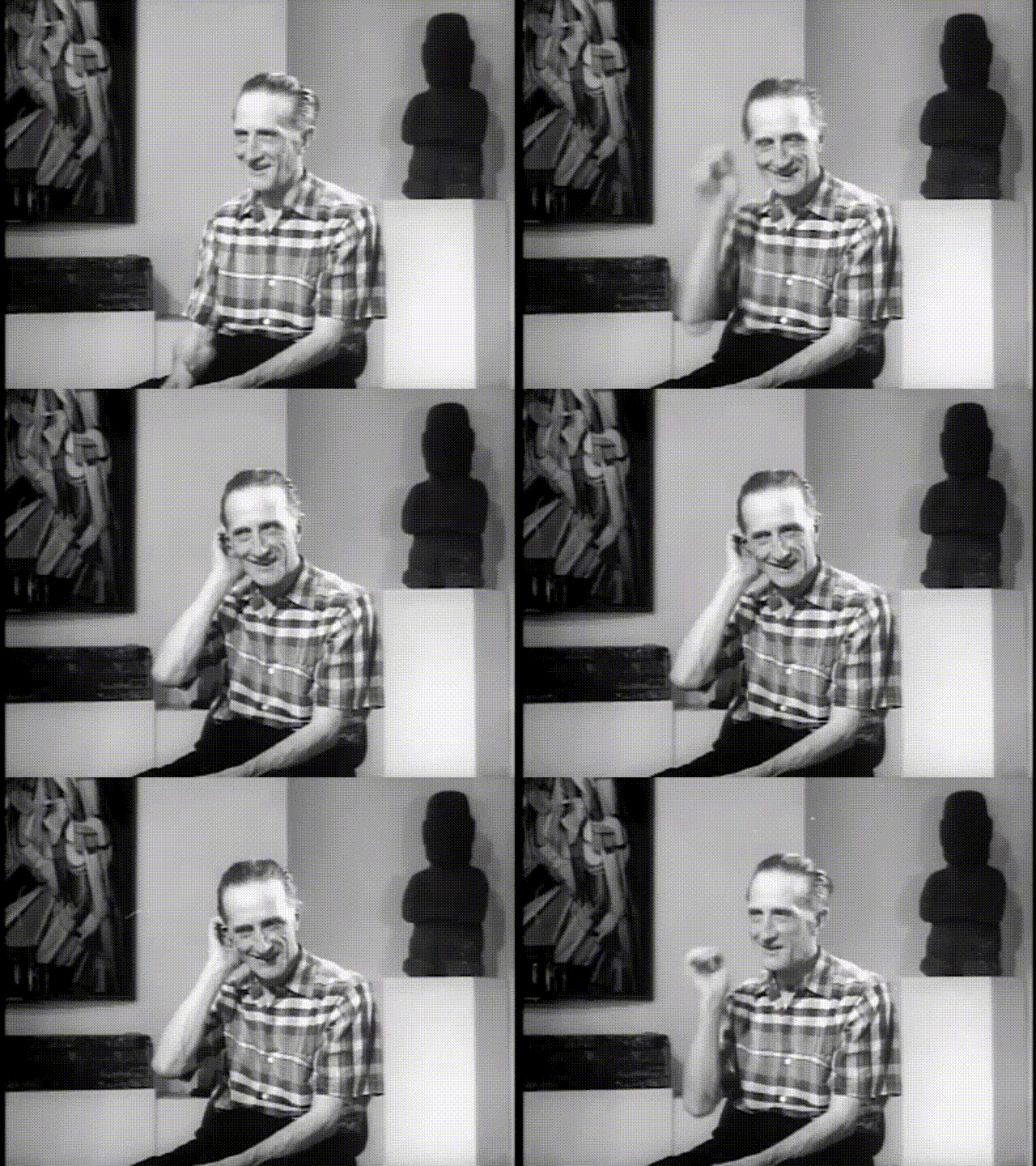
Duchamp came over. His clothes were white, his staff long. He was Saruman, if you ask me.
I was in a room with him. What the fuck am I supposed to ask Duchamp?
In the end this came out:
– Does Duchamp have financial problems? – No, he replied.
Good to know, though I guess one could have figured that out without asking...
I could see he was a bit disappointed, the question was a letdown, so I tried again:
– What I should have asked is what it was like to strike a deal with the devil, or were you always friends?
He burst out laughing.
By the way,
next to the bed
we were lying on the floor,
like some teens(…)
(2021, 07.10)
I met a man who blocked out the sun.
One of the leaders, after I told him I wouldn’t really want to take the position of evangelist in the church because I believed my vocation was to be an artist, explained to me that the artist, as such, is not among the gifts of the Holy Spirit, since those are given exclusively for the building of the church, not for play. Play, in its pejorative sense, was a recurring reference point in the church. Its source is the story of the golden calf in the Old Testament, where play appears as the aftermath of idolatry, as some kind of base behavior associated with demonic influence: “they ate, drank, and rose up to play,” as Károli translates it. For me, however, play itself is freedom. In it, the frustration and pressure to conform of social life fade away. It absorbs boredom, devours time.
“I believe that a piece of plastic — a ruined plastic washbasin — can be just as sacred as the Evening Star. But salvation must not be granted in advance. If this is not elemental in my gaze or in my perception, then one must not say anything better about that thing — in fact, it must be pressed downward. I would even say it must be pushed under water. Plastic must be made more plastic, and at that very moment it begins to cry, and under the weight of the ordeal it lets out a scream like that of the martyrs.”
(János Pilinszky, 1979, radio interview, excerpt)
Once, under the influence of THC, I felt a strong urge to find a pattern in the parquet floor of the apartment that I could identify with. Instead of the repeating pattern of the parquet, I immediately began to focus on the material of the wood itself. I started along a grain that appealed to me, and soon arrived at a sizeable knot. Unlike the linear structures I had followed so far, it had a concentric quality, but my maximalism was bothered by the fact that I was essentially focusing on a weak point in the wood — a flaw. I decided to exchange the form and continue the search. I moved on across other grains and knots. Then, after scanning roughly a square meter of surface, a strong doubt arose that I might not be able to find any unique quality in the floor that wouldn’t make me want to keep searching further. At that point — perhaps after briefly zoning out — I noticed a blurry patch, brighter than anything else, moving across the surface of the wood in a straight line all the way to the edge of the floor. The moment I realized I was following the reflection of the doorframe, I experienced a catharsis. I had found what I was looking for: the point where I could escape the floor’s surface.
(2000, Liliom st., Bp.)
For me, creating is a dialogue. With materials, themes, thoughts, memories, people, and so on. Exchanges in which ideas may surface seemingly out of nowhere. As they take shape, they begin to hint at what they want. I can only catalyze the process. Heavenly manna. It does not necessarily arrive when we want it to, but when we are able to receive it. If we are inattentive, we may miss the meeting altogether; at other times we are faced with long and deep silence. Both situations are extremely frustrating for the creator. One’s own adequacy comes under scrutiny.
In such moments, tense urgency does not help. But what if the creator runs out of patience and needs immediate reassurance about their own abilities? It may lead to counterproductive results, but it can also be seen as training. Gags that will never be used appear, along with echoes and after-images — things that are trivial in themselves, yet may later become additions, components. At this point there is no categorization or censorship, only collecting. I have only one task: to record every little fragment, because this is what I must live from. The forcing can escalate all the way to burnout. Not that it is necessary, but sometimes someone has to crash into a wall before they can finally loosen up. Because that is indispensable for the process to work. When one finally surrenders, the tension disappears. The noise generated by panic subsides, and to the creator’s great surprise the solution begins to take shape — something that had been there all along, only they had been standing on it.
In the great silence, above the pyramid, Gergő releases the little ball.
There was no other work, so the artist signed up for football. Actually as a goalkeeper. The coaches and the players looked at him with huge eyes: – will it work, won’t it?
Because he’s afraid of the ball, and he’s never even tried.
Where is that ball? That rock-hard one, smashed hard, the extra big one into the goal?
We won’t find anything else for a goal half a field wide, and the storm is already around the corner.
At least the artist is funny.
The zombies were locked in the back room, from the direction of the corn farm, from the direction of the kitschy sunflowers. There were children among them too, mostly children.
They went out to steal time, and then they were fucked, because they turned into zombies.
What use is a watch to them, or a tie, or style advice? the do / the don’t / or the never?
So the zombies were kept in the back. Sometimes they were let out to use the toilet, and maybe for entertainment.
They also called it a church service among themselves, when Maria Goebbels and Imre Enigma did not eat by the back garden, and the kung fu kicks were gathering.
It might have seemed strange to a zombie, and the sunglasses that looked too good.
There were clashes sometimes. And when there weren’t, it was still hanging in the air: children’s fights, white-clothed, style wars, white-clothed relatives who are no longer alive but still make music live.
(Stuttgart, 2019.11.29.)
Perhaps somewhere around the 647,281st utterance of the word “God,” in a careless moment, it happened: after a click too faint for the ear to hear, the ornate hand of the clockwork of our innermost motivation turned from faith in God toward system compliance. And as if that were not enough, it began to twitch slightly toward unreflective arrogance. Then it got stuck there for a long time.
“Either you die a hero, or you live long enough to see yourself become the villain.”
(Harvey Dent, The Dark Knight)
☹ Heretic Zoli ☹ Direct Poisoning Tomi ☹ Islam Feri ☹ Amok Gyuri ☹
Very Fucking Marine
Perhaps God had very little to do with what we were doing in His name; perhaps He also enjoys running into dead ends. We, for our part, tried to get the most out of ourselves. We believed we were accountable only to Him, and no one dared to mess around with that. We pushed forward with machetes, trying to outdo one another in collecting testimonies (experiences that, for a believer, testify to the existence of God), but in truth we were living fewer and fewer of them.
We tried to remain constantly present, so that we would not miss the moment when the long-awaited sign of the Son of Man would appear in the sky and the fires that would transform the world would sweep across everything in an instant. Then, after a long wait, it was as if we had managed to catch something in our effort to rent venues capable of accommodating ever larger church services: we discovered that there was such a thing as a Sportcastle, and that one could even long for it...
“It's a land that God, if he exists has created in anger. It's the only land where creation is unfinished yet. Taking a close look at what's around us, there is some sort of harmony. It is the harmony of overwhelming and collective murder.”
(Werner Herzog, Comment on the Jungle)
I’m afraid of Hungarians.
God is a Hungarian.
(...) they lead you around through the back entrance of the church, down the cheaply painted spiral staircase, but careful, they’re taking you to be fertilized! some kind of Midsommar-like adventure, kindly and almost unnoticed, step by step freeing you from the burden of your mind.
if you buy into it, you're done.
(Bp., 2020.09.08.)
Goals that might even come true, provided the participants share the same vision and each carries out their part of the work required for its realization. Each making their own small or large sacrifice, willingly and with a song, as if to motivate the whole environment. But even then it is by no means certain that the thing will actually come into being. Especially if we hope for supernatural intervention, because then an unforeseeable portion of the work falls on the Creator. Which is not so simple, since He would have to suspend a few Newtonian laws, even if only temporarily. But will the boss be willing to put in His share of the project?
“Suddenly the sky turned green and the air became heavy. Then the sirens went off and we went down to the basement. You could tell it was the Indians’ revenge...”
(Tornado experience of K. B.)
Let’s suppose an impulse sets out from the realm of the absurd, and you happen to stand, with a good feeling, at the right place at the right time — exactly where the divine force enters the visible world — and behold, it draws its arc precisely through you. But I suppose it’s obvious that this doesn’t mean you did any of it… otherwise, well… anyone can say this will happen or that will happen… and afterwards explain that this wasn’t good, or that wasn’t good… The happening of the thing — or the non-happening of the thing — is what defines it.
“This is a diary.
If I write it, it exists.
If I make it, then I moke it!!!”
(...) I should’ve taken a selfie with Duchamp, for fuck’s sake!
(2021, 07.10)
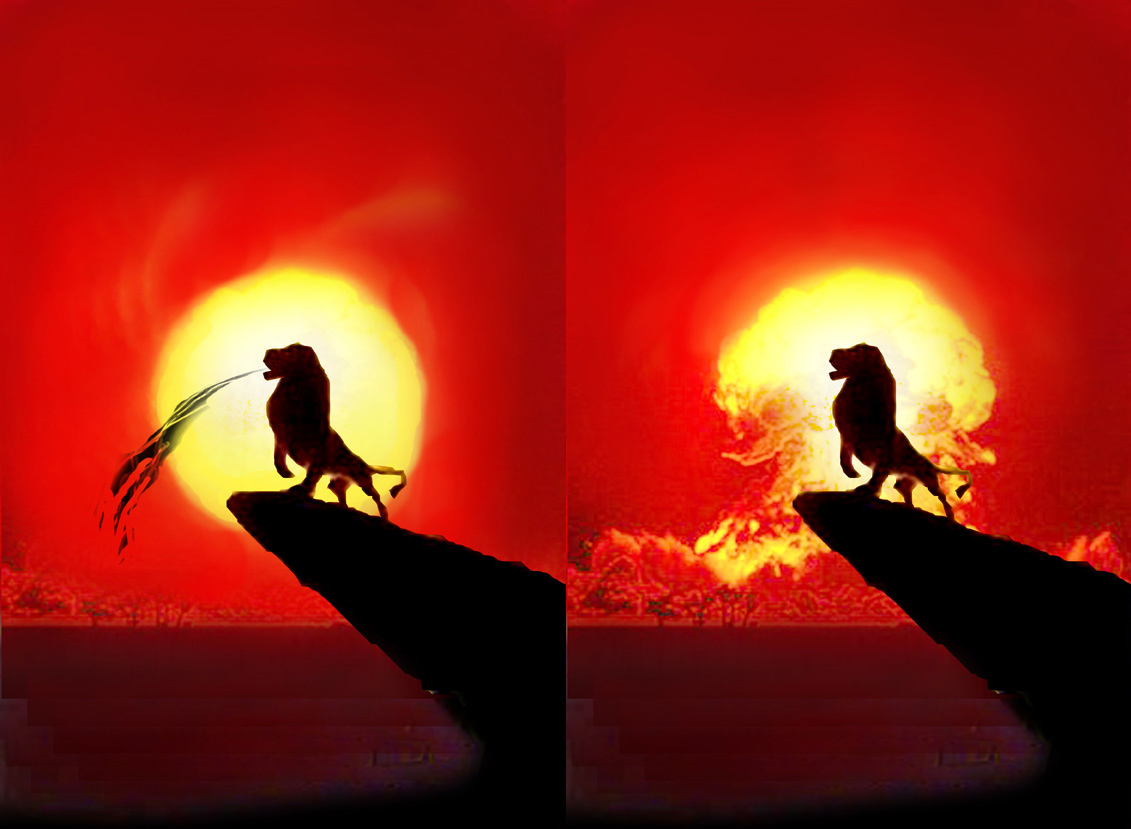
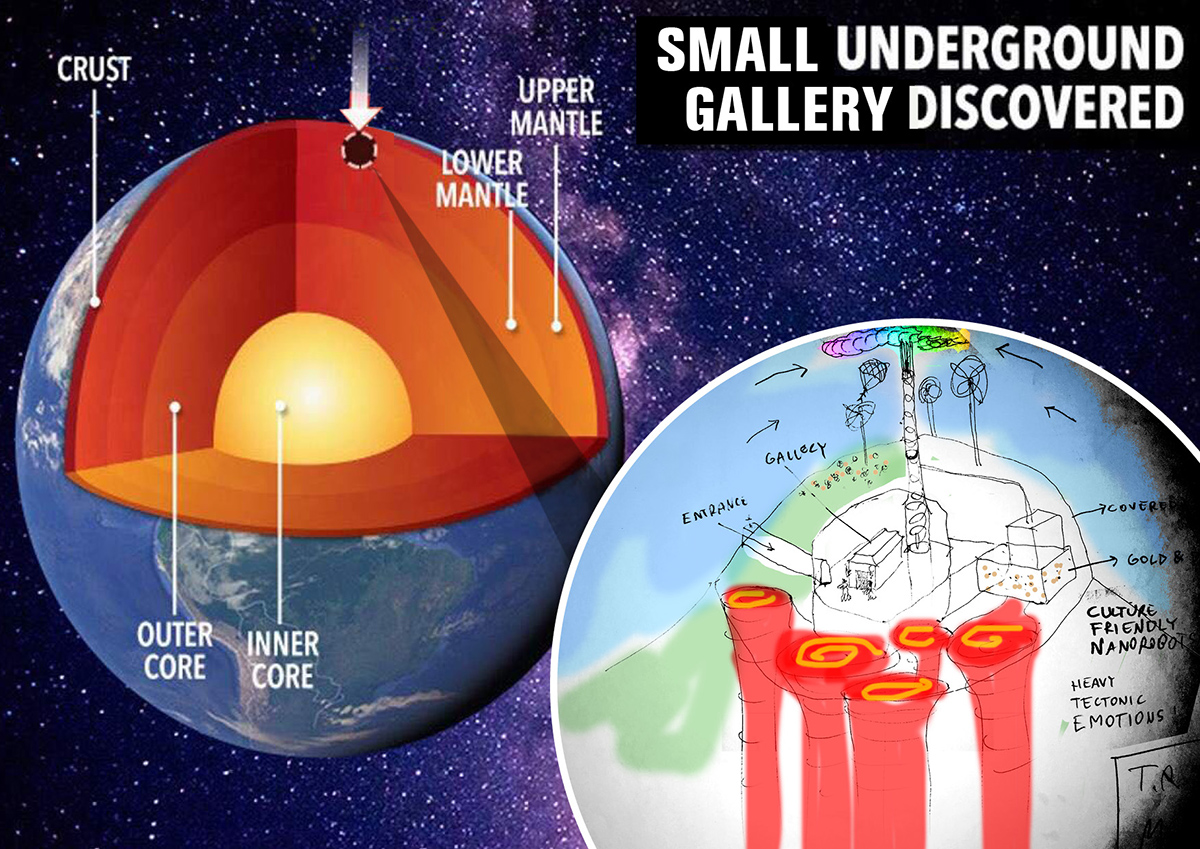
The gallery, dreamed into a volcanic crater and optionally floodable with water, hangs in a heat-resistant cavern carved into the lithosphere, directly above the magma. The exhibition space can be accessed through a crypt hollowed into the side of the mountain. During events, colored smoke flows outward through the multifunctional vent that also channels the frenzied eruptions, blown in all directions of the wind rose by industrial-scale wind turbines. In addition to filtering harmful sunlight, the smoke serves a mood-enhancing and enticing function thanks to the enriched oxygen and aphrodisiac added to it, extracted from special, permanently blooming flowers cultivated on the crater’s covered surface. The spiral staircase inside the vent functions as an atmospheric exhibition space; those with stronger nervous systems may descend from the top of the structure using parachutes that also operate as solar panels. The periodically intensifying and fading rumble of earthquakes and crackling fire that seep into the outer areas of the gallery is occasionally made ceremonial by the ringing of bells. Further amplifying the atmosphere is Lil Holt’s song Facing the Sun, played on an endless loop (“Trouble everywhere, trouble everywhere, trouble everywhere, trouble everywhere, trouble everywhere, trouble everywhere, trouble everywhere, trouble everywhere ♾.”).
(2019, The Rest In Peace statement, Leopold Bloom Prize application, excerpt)
You can see its spine, the slimy sac.
It once happened that after catching himself in the middle of prophesying, the dear leader, overheated by the fire of his own charisma, said the following into the microphone in front of several hundred people: “I guarantee it will happen!”
༼;´༎ຶ ༎ຶ༽
I would have most liked to shout out loud: “heeeey, fuck, are you taking that back?!” Of course then I would most likely have had to face at least the accusation of being demonized for disturbing the order of the church service like a wild boar. Not to mention the swearing, which would have clearly signaled that it was not the Holy Spirit speaking through me. So instead I kept quiet...
(I honestly don’t even remember what the prophecy was about, but since I can’t recall anything earth-shattering from that time, it most likely went into the same bag as the other grand-sounding, burst balloons.)
(A man stands under a tree holding a snake.) Man:
– If I strongly believe in JESUS, I will survive the snakebite.
Snake: – If I strongly believe in SNAKE JESUS, you will die.
Tree: – If I strongly believe in TREE JESUS, both of you will die.
(A lightning bolt strikes the tree. A falling branch crushes both the man and the snake.)
Tree, bursting with joy:
– Thank you, TREE JESUS!
(Family Guy)
The life of a believer is the real advertisement — if it works. If it doesn’t, it’s a blow to the cause. This is how we used to see it: success follows the blessed person (signs and wonders), and curse follows the sinner (illness, death). But what if judging all this is not so straightforward? Is it even possible to assess someone’s state of faith — or even a single action — without knowing the context, merely on the basis of external signs?
1. Black death on the scythe of white death
2. White death on the scythe of black death
In the Book of Job we can read at length about the desperate effort of three men who try with great determination to uncover the reason why their friend Job’s life has hit rock bottom. The phenomenon of paradox does not really fit into their worldview, even when it unfolds right before their eyes, partly through their own involvement. For Job did not receive the harshest blows because he was the most sinful, but quite the opposite: because his integrity was unparalleled far and wide.***
As if losing his children, his entire fortune and his health overnight had not been enough, he also had to endure the people closest to him accusing him, blinded by prejudice, of a sinful life, even outright wickedness. Still, we must acknowledge the friends’ attempt at empathy. When they arrived they first burst into tears, then performed a full clothes-tearing / ashes-on-the-head ritual, and after that they kept silent for seven, yes seven, days. A remarkable development (who would have thought!) is that after this they were still able to switch into terminator mode. But that’s how the overzealous are. They will do everything for the Lord, even the things they shouldn’t. Especially those.
A grindcore techno band contaminated with massive electronic noise and guttural vocals. Its crosshairs are fixed on the self-righteous, arrogant Christian who lives out his frustration by intimidating others. He is afraid and spreads fear. His growl echoes through the distance…
(Horribile Flagellum)
Gecijóga – taught by me
Across several rounds, Job was forced to defend his truth with determination against the relentless arrogant attacks. He remained alone with his opinion until he began addressing his words to God. At that point God appeared — like the devil painted on the wall — in the form of a whirlwind, to give him justice. Then He also condescended a little, just so Job’s head wouldn’t get too big for having passed the shitty test. He therefore outlined a few obscure natural phenomena demonstrating the immense complexity of how the world works. The attempt to invoke the sublime proved successful, since it silenced Job and his companions in an instant.
At the same time, G. K. Chesterton points out that this manifestation of the Creator amounts to lowering Himself to the level of self-justification****. It is as if He were apologizing for not having managed to tie off completely the threads of creation that were meant to be perfect...
¯\_(ツ)_/¯
***"Job is not told that his misfortunes were due to his sins or a part of any plan for his improvement. But in the prologue we see Job tormented not because he was the worst of men, but because he was the best. It is the lesson of the whole work that man is most comforted by paradoxes”.
****"To startle man, God becomes for an instant a blasphemer; one might almost say that God becomes for an instant an atheist.
(G. K. Chesterton, Introduction to the Book of Job)
“Looking for the sake of looking is nothing other than losing oneself in purposelessness. Man is left alone; and as everything around him begins to thin out, his own being appears before him, threatened by passing away, by nothingness. This is not far from the withdrawal of creation. And yet the beginning held the hope of a new creation.”
(F. L. Földényi, The Night Side of Painting)
Andy, investigator of the Leviathan
Crimes had happened at the city lakes. Strange water vortices, yet only the large web-footed seahorse was swimming in the water. Strangely enough, that calmed us down.
Then came the teaching about crossing the water. Apparently the American cultists once used a ford. A guy with a crossbow was explaining it to the police by the highway, waving the weapon around, but nobody seemed bothered, since he was native...
So that’s where people cross the water, leaving no traces. But if you go in the wrong place, the current sweeps you away. There is, however, a narrow strip, maybe ten centimeters wide, where you can almost slide across like on a chute.
One guy demonstrated it, but drifted off to the left at the end, barely making it across.
I approached from the right, from the deep water side, and no matter how I tried to climb up the current swept me away, because instead of grabbing hold I was worried about my phone in my pocket (which was already underwater anyway).
Then I calmed down, realizing I had a neoprene pocket.
Meanwhile the water was burning the hell out of me.
Stories were spinning left and right, people on the shore, dialogues, narratives, a calm picnic atmosphere, the feeling of progress.
And then of course a waterfall, like a typical dramaturgical turn.
There was narration there too, saying things like “it pushes you further than you’d think, you can’t escape, but you’ll learn from it.”
I don’t know, at the same time a calming and numbing feeling that even if I can’t escape I should accept it, that I’ll learn something from this.
Anyway: survival. So I surrender myself to gravity.
And then the waterfall, but something enormous, I just kept falling and falling, far longer than I would have thought.
The image slowed down, stuttered, then froze. The view breaking into glitchy fragments, as if the fall would never end (with a purple duvet, by the way).
And as I fall I see there is no water below, the riverbed has dried out. Massive drought. (Where did the water go?)
I pull the duvet in front of me and crash.
Narration continues, saying I landed on some kind of water bladder that enclosed me, face down.
They are already rushing to rescue me so that I don’t suffocate in the bubble.
Like a Formula 1 crash, when they pull the driver out of the wreck (out of the suit, the helmet, the car). They peel me out of the cocoon.
They say I didn’t hit myself too badly, but my forehead hurts.
They unwrap me, I’m basically born, I take a breath, cut.
I like those two girls. We go together, boating on the water.
Somehow steering doesn’t work, we reach shallow water, avoiding the reeds.
I’m afraid we’ll run aground.
L has to steer through a narrow gap (perhaps she was one of the girls?), but we get stuck.
I don’t dare jump into the water because of the earlier Leviathan story...
Then somehow I’m in the water anyway. I make it to the shore and follow a guy heading to some church.
Yes, he’s going there.
Many people already there. Charging up, whispering, becoming inspired.
Then one inspired guy stands up on the table and speaks,
like some self-appointed prophet:
– love.br>
A syrupy smile, eyes closed,
the very face of idiotic enlightenment.
I thought: well, I’ve never heard that word spoken here before.
Then he continues:
– love, let’s make love
He said
So I thought: okay, this must be time travel. Let’s see how it used to be in a place like this,
like in a cult documentary.
Alright then, I’m watching.
(with my eyes secretly searching for escape routes).
Then the leader, seeing the self-appointed prophet and that more and more people are getting into it,
gives in.
– yeah, yeah, okay, let’s make love!
Then there’s some collective flower licking, something red,
people relaxing from it.
Then the flower runs out. Big problem. The leader walks us around.
He finds some yellow flower in the storage room. That’s what we have to lick.
I lick it suspiciously, a splinter goes into my mouth, like from a cactus.
That bastard doesn’t even tell us what he made us lick.
Another guy whispers to me:
– that could have paralyzed you, because it’s that kind of thing.
Thanks a fucking lot.
And the guy goes around giving that shit to people instead of the red flower.
That’s when I snapped.
I didn’t see anyone having sex.
Only a crowd in the mud,
out in the rain.
Turned against each other.
Harsh lights,
people ready to rage,
preparing for something,
or already past it,
or maybe this was it,
or maybe they were just waiting for the start.
I was more interested in who stayed behind in the tent.
Because there was a girl who had been thrown out with all sorts of made-up excuses:
she failed this test, she failed that test,
But in the end it turned out
the reason was purely aesthetic.
(...)
(Székesfehérvár, 2019.11.04.)
Narnia is a lie.
If we strip away social functions, a collective dream world begins to appear (the monomyth), with the archetype of a heroic figure envisioned by Joseph Campbell in The Hero with a Thousand Faces. With the help of the dramaturgical code that forms the basic structure of countless Hollywood blockbusters, generations have been programmed through different interpretations of the same clichés. The human mind is defenseless against the socially embedded forms of mediatized manipulation, whether refined or aggressive, whose campaign-like messages seep uninvited into our thoughts. If consciousness does not rebel against this oppressive flood of information, it must settle for drifting through life in some degree of misguidance, living a life that is not entirely its own.
Alone, in splendid battle attire, it approaches its prey. After a foreplay focused on surface forms, it asserts its dominance over the rear openings of helpless vehicles with movements that imitate mating. It does all this with the help of an artificial phallus projecting forward from its face (“The psychology – head over heels*****”). It never returns to its victims.
(***** Eccentric Manifesto, made by FEKS, State Publishing House, “Eccentrism”, Eccentropolis, i.e. Petrograd, 1922)
Borsos Lőrinc, Bolla Szilvia: Night Service, műleírás, részlet, 2019
One possible source of frustration may lie in the subconscious. It may stem from the fact that an individual conditioned by various forms of programming and social norms cannot know in advance where their dream-hero (themselves) has been cast in the story: among the fallen, or among the victorious. They can only hope that a script exists which holds a favorable outcome for them, while the path leading to it remains hidden. A struggle demanding great patience and perseverance awaits them. Their journey is hindered by various degrees of deviation, unfulfilled promises, and disappointment. It is almost a miracle if, despite all this, one of their freely conceived thoughts manages to take shape in the world. Yet even that can only count as a tiny victory compared to the whole war — a war that is ultimately about relinquishing control and accepting oneself.
“Self-transcendence may follow a downward path, one along which we can descend below the human and personal level...
Under what circumstances, and to what extent, can this downward path be used for spiritual self-transcendence? At first glance it may seem obvious that a downward road does not lead, and can never lead, upward. Yet in the realm of reality things are not as simple as they appear in the neatly ordered world of our formulations. In actual life, a fall into the depths can sometimes mark the beginning of an ascent. When the shell of the ego cracks and the subconscious and physiological differences that form the foundations of personality begin to come into awareness, it sometimes happens that, briefly but apocalyptically, another difference flashes before us — the one that is the ground of all existence. As long as we remain enclosed within the limits of our isolated Self, we fail to notice the multiplicity that is not ourselves, yet with which we are connected: the organic not-self, the subconscious not-self, the collective not-self (those parts of the psychic medium in which all our thoughts and feelings exist), and the immanent and transcendent not-self of the Spirit. Every step out of this isolated egoism, even if it occurs along the downward path, may for a moment reveal what lies beyond ourselves — even the highest level of being.”
(Aldous Huxley)
At dawn, when I had grown tired, I said to myself:
“Come on, Jesus, let’s go to bed now. I’m feeling pretty exhausted. Tomorrow will be a new day, and then I’ll show you many other things as well.”
The trams set off on their everyday rattling rounds, and we, as if satisfied with the work we had done, drifted into sleep.
 T H E Y A R E L E G I O N



 (Growing Optimism)